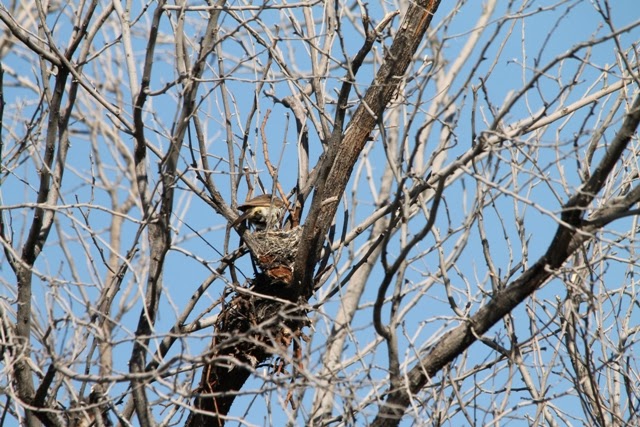
Several months ago, I put together a post showing photos of Vermilion Flycatcher nests. I thought I’d share this one, as well – for the third year in a row, there’s been a nest in this tree. In 2012 and 2013, the nest was in the exact same location; this year, it was perhaps a foot away, if that. Most of my Vermilion Flycatcher nests are fairly close to where they had been located in past years, but this wins the site fidelity prize!
Monday, May 26, 2014
Thursday, May 22, 2014
Nevada Bird Count - Botanical Edition
How it has gotten to be the latter part of May, I’m not sure, but time is flying along with the birds!
The
Nevada Bird Count crew has been out and about now for a little over a
month. In addition to our bird surveys, we also do a lot of habitat
surveys. Earlier this month, David Charlet, a botanist at the College
of Southern Nevada, graciously gave us a day of his time, and we all had
a blast scouring the Spring Mountains, becoming more familiar with the
vegetation within blackbrush and pinyon-juniper habitats, among others. Thanks David!
Friday, April 25, 2014
More Maps - The Sparrow Formerly Known As Sage
Some time back, I posted the Gray Vireo maps, and then couldn’t resist mapping Sagebrush/Bell’s Sparrows. Between the Breeding Bird Atlas and the Nevada Bird Count, we have a lot of location records within the Great Basin; fewer within the Mojave Desert. The data aren’t mapped separately by species, since they were collected as “Sage” Sparrows. Precisely where the two species “meet” within Nevada is unknown (except for the region near Bishop), but it’s certainly fun to stare at maps and speculate … and then even more fun to head out into the field and investigate!
Next month, we'll be doing some banding, measuring, and hopefully recording of our birds breeding in the Mojave Desert - and then depending on how that goes, we'll also work our way north for aways, for as long as our time permits. While out and about, if you find territorial "Sage" Sparrows - and even better, nest locations! - please do shoot me an email with the UTM and datum. Thanks, and
Happy birding!
Jen
![]() |
| "Sage Sparrow" detections and breeding locations. |
Tuesday, April 22, 2014
Friday, February 28, 2014
Back in the Field!
![]() |
| Truckee River |
Across the nation, bird biologists are gearing up for the upcoming field season, and GBBO is no exception. Here’s a run-down of the field work that we’re starting up over the next couple of months.
We’ve mentioned before our efforts to monitor the populations of fish-eating waterbirds on Walker Lake and other terminal lakes in western Nevada, and this work is continuing. The ongoing drop in the water level in Walker Lake has led to increasing concentrations of dissolved solids, decimating the lake’s fish populations and the birds that depend on them. If ongoing efforts to secure more water for Walker Lake are successful, we hope we’ll be able to document waterbird recovery in the future.
| Pine Nut Range |
Also on the docket is our statewide Golden Eagle inventory project, in collaboration with the Nevada Department of Wildlife, where we’re working together to better understand how eagles are distributed statewide, so we can provide the Bureau of Land Management and other agencies with the information they need to protect Golden Eagles in the face of energy development pressure and other possible conservation challenges.
Starting up is a new Elf Owl study in the Mojave and Sonoran Desert regions of California and Arizona. This will be our second Elf Owl project for the Lower Colorado River Multi-Species Conservation Program (LCR-MSCP). The Elf Owl is a conservation priority species for this program, and our project is designed to better understand the habitat needs and preferences of this tiny owl, so that restoration activities along the LCR can be designed to provide maximum benefit.
![]() |
| Elf Owl, copyright & courtesy of John Stanek |
We are continuing to use the expertise and skills developed in designing and implementing bird surveys and monitoring projects to benefit management programs for stray dogs and cats in the US, and around the world. Free-roaming cats and dogs can have negative impacts on wildlife and public health, and they also suffer from frequent abuse and neglect. Previous efforts to manage stray animal populations have often been ineffective because of insufficient monitoring, lack of analytical rigor, and a poor understanding of animal population dynamics. By providing consultation services to organizations that are seeking to better manage stray animal populations, GBBO is helping to rectify these oversights and ensure that stray animal management programs are effective.
The Lower Colorado River program continues this year – and, in fact, trail clearing starts up next week! Since
2008, we've been conducting area searches within riparian
corridors in the river's historic flood plain as part of
the LCR-MSCP. We're surveying sites where riparian
habitat has been restored, as well as those on federal,
tribal, state, and private lands to obtain population size estimates,
trends, and distributions for six LCR-MSCP species of concern (Gila Woodpecker, Summer Tanager, Arizona Bell’s Vireo, Sonoran Yellow Warbler, Gilded Flicker, and Vermilion Flycatcher) as well as many other riparian birds. Along with this population monitoring, we're also developing detailed habitat assessments for the first four of the above species. More details can be found in our annual reports at http://www.lcrmscp.gov/steer_committee/technical_reports.html.
In 2013, we began a new component
of the project: monitoring potential impacts of saltcedar
beetles on riparian birds of the LCR. Here, in the center of the invasion by the saltcedar beetle, we are able to study the effects of defoliation as the impact unfolds. Impacts of defoliation may be
sudden or they may occur over an extended period of time. For example, sudden effects might result from nests being exposed to the sun (and thereby to higher temperatures), or by depressing
insect populations through sun exposure. Alternatively, impacts might occur over time
as suitable habitat becomes less and less available because of the lack of
canopy cover and lack of recruitment of other suitable vegetation. This season will be the second of the three-year project.
Last but not least – and near and dear to my (Jen's) heart! – is the Nevada Bird Count. The NBC is a statewide bird monitoring program (with a few surveys dispersing out into adjacent states), that focuses on point count transects supplemented by area searches – and a whole lot of habitat assessments! I just checked our database, and we have 892 transects set up so far; in 2014, we’ll be surveying a subset of these, along with a number of new locations. The NBC acts as a sort of umbrella, encompassing a lot of different projects. This year, we’ll be continuing our surveys at Warm Springs Natural Area, as well as those along the Truckee and Walker Rivers. The Pine Nut Range is another big project area, where we’ll be investigating pinyon-juniper treatment areas as well as fire impacts from last year’s blaze. We’re also going to be looking at bird communities in sagebrush and blackbrush habitats in the Great Basin and Mojave Desert, particularly in relation to linear disturbance factors like roads and powerlines. Finally, we’ll be monitoring restoration areas at Pahranagat and Desert National Wildlife Refuges. It’s going to be fun! There are several more NBC-related projects in the hopper, too, so stay tuned!
Happy birding,
Jen, John, and Amy
Thursday, January 23, 2014
Lucy's Warbler Nest Sites
Lucy’s Warblers are a species of conservation concern here in Nevada. A small, cavity-nesting warbler, in Nevada they’re found primarily in riparian areas and mesquite woodlands. They typically nest between 0.6 and 6m above ground, in a wide variety of locations, from crevices formed by loose bark, to natural cavities, to old woodpecker cavities – even (rarely) crevices or burrows in rocks or banks [1].
Okay, on to pictures!
This first one exemplifies the nests that were in the burned screwbean mesquites, with the Lucy’s Warblers building in “cavities” created by peeling bark.
The next 3 pictures show Lucy’s Warbler nest locations behind peeling bark in burned-over cottonwoods. In the third set, this nest was located in the same tree as a Western Kingbird nest. The Kingbirds lived up to their genus name, Tyrannus, and were very territorial. On one occasion, I watched the Kingbirds prevent the Lucy’s Warbler pair from bringing food to their nestlings for over 3 minutes (and I’d arrived in the midst of their dispute and been watching for some time before I thought to look at my watch!).
This nest location in a burned cottonwood was featured in a previous post, and the nesting attempt was evidently abandoned. Two other species began nesting in this snag, as well: Brown-crested Flycatcher, and Western Kingbird. These also abandoned their attempts. This could be chance (I did see several other nesting attempts by Lucy’s Warblers and Western Kingbirds that didn’t go anywhere), or perhaps the lack of shading from any other vegetation led to it being too hot, or [insert your explanation here!]. On the other hand, it was the most heavily-used perch tree on my plot, by a wide variety of species!
Below is a Lucy’s Warbler nesting site behind some peeling bark of a burned-over cottonwood that is resprouting. This tree served as a nest site for 2 successive years; in the second year, the new growth had become tall enough to hide the site from view.
Last, but not least, is a Lucy’s Warbler nest location within a natural cavity within an ash. I had walked by this location numerous times during my surveys, without realizing the nest was there – on this survey, the pair was bringing food, and the nestlings were creating a racket! (You can see feces on the nest’s rim, from either older nestlings or the female.)
- Jen
Thursday, January 9, 2014
Vermilion Flycatchers: nests, nests, nests
I was tagging photos last month, and realized I had a fair number of Vermilion Flycatcher nests, so I thought I’d share them: (1) because they’re interesting, and (2) because I figured they may help folks develop their own search image! Sadly, I had some great ones a few years back, but the camera they were on fell into the Walker River before I’d had a chance to download them. (And yes, I now clip my phone to its case – and the case to me – just to prevent this sort of thing from happening again! Lesson learned.)
All of these photos were taken by me at Warm Springs Natural Area, except for one by Amy Leist down along the Lower Colorado River (thanks Amy!). Of the pictures at Warm Springs, only one nest (2 pictures) is from prior to the 2010 fire (again, see The Walker River Incident), and most are from 2012-2013. Interestingly, the fire didn’t seem to impact the Vermilion nesting as much as expected (at least on a short-term basis): as you can see, the majority of these nest photos are within burned and leafless screwbean mesquites and cottonwoods. This may be because, even prior to the fire, they typically began nesting early while the screwbeans lacked leaves, anyway. Depending on the photo, it may not be obvious, but the nests were shaded for significant portions of the day. The exception was a nest in 2012, which was fairly high up in a burned tree, and did not have that shading – the female there ended up spending a lot of time acting as an parasol!
Based on their Birds of North America account [1], the most important nest trees include willows, cottonwoods, and mesquites. As I mentioned, at Warm Springs, they appear most frequently in the cottonwood/screwbean mesquite habitats, but also use honey mesquite. In the literature, honey mesquite appears more frequently than screwbeans, which is unsurprising given it has a much larger range.
Nests are typically located 2-6m, and up to 18m, off the ground, though this depends greatly on the kind of habitat they’re in – nests in cottonwood habitats are understandably much more apt to be higher than those in shorter mesquite stands.
This first photo was taken in 2009 – you’ll have to squint to find the nest, but you can see some fine nest material on the top of the branch – the nest itself has been constructed within a forked branch. In the next photo, the black arrow points to the nest location relative to the screwbean plant itself. This stand had large numbers of Vermilions in it, and was a fairly open screwbean mesquite stand with scattered honey mesquites and quailbush, and (often) a dense carpet of grass.
And another nest within a screwbean mesquite. Again, the nest is constructed within a fork, and was approximately 6 feet high.
The next two photos were taken in 2012 and 2013, in another scorched ash – though in 2012, it still had some leaves. As you can tell, they refurbished the same nest location! A third photo, with the arrow, shows the nest location relative to the rest of the tree.
| Vermilion Flycatcher nest, 2012 |
| Vermilion Flycatcher nest, 2013 |
This pic, taken in 2012, may be in another burned screwbean (it’s a mesquite, at any rate), and is the one I mentioned earlier, that did not have shade … you can see the female standing on the nest’s edge in the photo. This may be the same pair that is starred (**) above. At any rate, this location is very close to that above.
| Add caption |
The next several photos are of nests within burned cottonwoods. Some of these appear to be built within forks, others do not (or at least it is not obvious); all are on fairly flat sections of the branch, and are shaded by branches above and beside them.
Anyway, that’s it for now! Happy birding,
-- Jen
[1] Ellison, Kevin, Blair O. Wolf and Stephanie L. Jones. 2009. Vermilion Flycatcher (Pyrocephalus rubinus), The Birds of North America Online (A. Poole, Ed.). Ithaca: Cornell Lab of Ornithology; Retrieved from the Birds of North America Online: http://bna.birds.cornell.edu/bna/species/484
Subscribe to:
Posts (Atom)

-9.jpg)
.jpg)
-6.jpg)

.jpg)